Applications of Acrylic Products: Uses and Scenarios
2026-04-13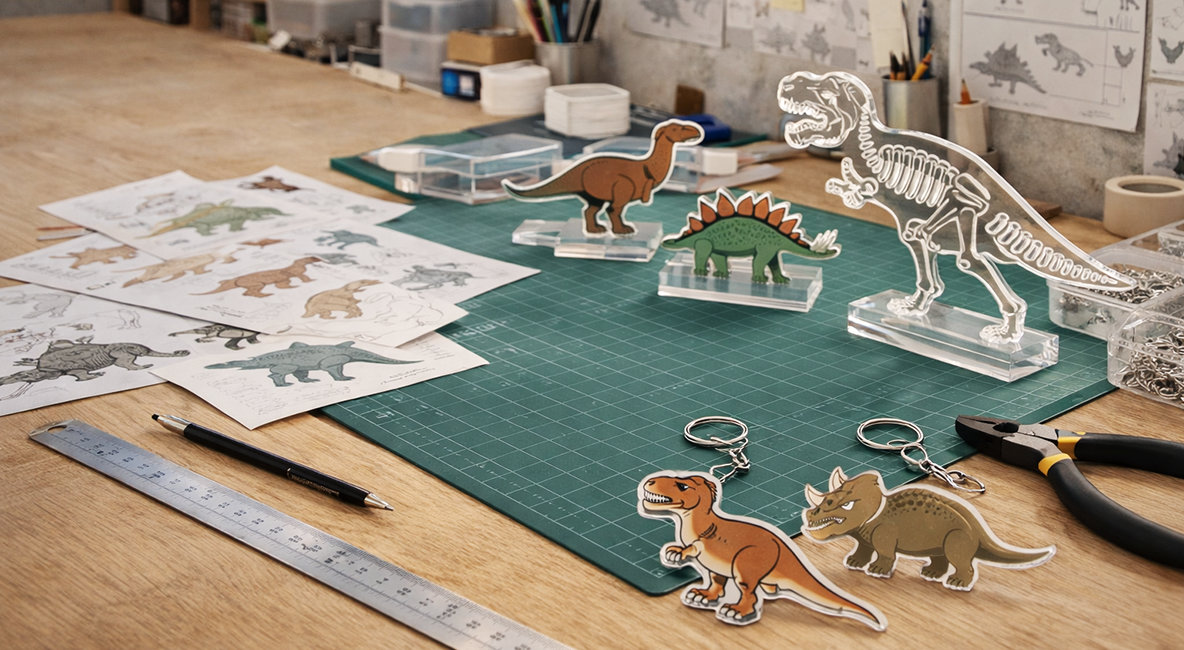
Applications of Acrylic Products: Uses and Scenarios
Acrylic is widely used in custom merchandise due to its high transparency, flexible processing, and stable production cost. From small accessories to display items, it can be adapted into various product forms for different usage scenarios.
Compared to other materials, acrylic offers a balanced combination of visual clarity and manufacturing efficiency, making it a practical choice for custom product development.
1. Common Acrylic Product Types
Acrylic can be developed into multiple product forms depending on processing methods and intended use:
▶️ Keychains and small accessories
Compact and lightweight, suitable for promotional giveaways and entry-level retail items.
▶️ Standees and display items
Layered printing on transparent material enhances visual presentation, commonly used for character or brand visuals.
▶️ Functional lifestyle goods
Such as signage, card holders, or simple organizers that combine usability with design.
▶️ Modular or assembled products
Multiple acrylic pieces can be combined into structured or dimensional items, increasing product variation.
2. Typical Application Scenarios
Acrylic products are versatile and applicable across different contexts:
▶️ Event giveaways
Suitable for large-scale production with fast turnaround, aligned with campaign themes.
▶️ Brand merchandise
Transforms visual identity into collectible items, commonly used in IP or brand extensions.
▶️ Exhibition and display items
Can function as identifiers or commemorative items with both display and portable value.
▶️ Retail products
Flexible pricing allows for both entry-level and higher-value design items.
3. Why Acrylic Works Well for Custom Products
The popularity of acrylic comes from several practical advantages:
▶️ Clear visual presentation
Transparent material preserves design details effectively.
▶️ High processing flexibility
Supports cutting, printing, and assembly into diverse shapes.
▶️ Scalable production
Suitable for both small-batch and large-volume manufacturing.
▶️ Stable production workflow
Standardized processes help maintain consistent quality.
4. Practical Considerations in Development
When developing acrylic products, several factors should be considered:
Design should account for thickness and structural strength
Printing methods (single-sided or double-sided) affect visual outcome
Hardware components should match usage scenarios
With production experience, suppliers can provide structural and processing recommendations at the early design stage to improve product stability and usability.
Taking Kim Hwa's workflow as an example, dimensions, thickness, and hardware can be adjusted according to different usage needs, allowing acrylic products to better fit real-world applications.
Conclusion
Acrylic is a highly adaptable material for custom products, suitable for events, branding, and retail applications. With proper planning and execution, it can deliver both functional and visual value across various scenarios.
Customization Process: